
Scope
And its power for trust and problem solving

There are many tools available to help troubleshoot when a skill isn’t working as desired. One of my “go-to” tools is to clarify and discuss scope, and I will share some introductory thoughts on this. I have a feeling I’ll come back to this one….
Firstly, let's define what I mean when I say scope
Scope
noun
The extent of the area or subject matter that something deals with or to which it is relevant.
"We widened the scope of our investigation"
The scope is the role of each person for a specific skill. Some parts of the scope might be obvious and set, ex; the base is lifting, other aspects are more fluid ex; who leads the tempo or determine arm position. Understanding and communication about scope provide a powerful tool in problem-solving and refinement of skills.
The question about scope has come up a few times lately when discussing skills with new friends. But the thought was also triggered when trying to cross the street in Hanoi for the first time.
Hanoi’s traffic is an intense, consistent flow of beeping motorbikes. No one will stop for you, but rather, the bikes zoom around pedestrians. In order to safely cross the street by foot, I had to simply move into the street, slowly and predictably, in order for all the beeping motorbikes to zoom around me. I had a strong urge to adjust around the traffic, but observing the locals I realized that within my scope was to move in a steady manner, making it easy for bikes to predict their path around me. Within their scope was to avoid hitting me. My scope included making their job easy, but not doing their job for them, as this would have resulted in jerky motions, and disrupted their flow.
If I translate this to acro, as a flyer it can sometimes feel scary to give up control of an aspect of the move. I will use reverse hand-to-hand as an example. As a flyer, I am tempted to try and balance myself to avoid going over (it’s scary, right?). However, my base is also balancing me. Add to this dynamic that what we feel is not always true.
Let me provide an example. When working on reverse hand-to-hand, my partner would always correct my underbalance. I could not identify the underbalance, and was feeling as if I was going over, counter-correcting myself. Our overlapping scopes resulted in the skill being unsteady and inconsistent. It’s like working for two managers, asking for conflicting tasks; nothing gets done well! Upon conversation, realizing we had very different experiences of what was happening, we determined new scopes. I asked my base not to correct the perceived underbalance, allowing me to feel my position. Ahaa, I fell under! This was great, all I needed to do was to come over a little more. Attempting it again, with the aim of me as a flyer finding my position, my base provided a steady platform but offered no corrections. Once the entrance was consistent, and I had recalibrated my position, we were able to revisit the scope. I was now able to recognise the underbalance, put myself in position, and was able to give back all balance duties to my base. My scope now returned to holding shape, and providing valuable feedback through pressure in the hand, allowing my partner to balance me.
Discussing scope is not only a powerful tool for problem-solving, but also to build trust and safety. Having verbal affirmation that my partner is accepting a certain part of the skill as their scope means they are prepared, and feel confident to perform this task.
Similarly, when using spotters I like to be explicit with scope. It can feel counterintuitive to not “save yourself”, but in an acro skill, it's often the safest thing to do. By explicitly determining in what situation the spotter will step in, and what I as a flyer will do, as well as what the base will do allows me as a flyer to fall in a way that is easy to catch, knowing that the other parties are prepared for this type of catch. A prime example is foot to hand. As a flyer, I can not see what is going on under me. Any corrections through my body risk destabilizing the skill. Large corrections and saves are not within my scope. Therefore, working with the base and spotters we discuss what to do if the flyer falls forward vs backwards. As a flyer, if I then feel that I am falling, knowing the procedure, I will stay within my scope, ensuring that my partners can do the same. Allow the motorbikes to zoom around you, move predictably, trust….
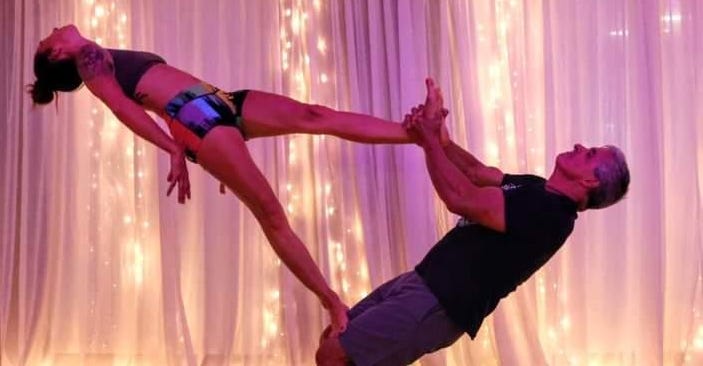
(Giving Jorgie all the trust he deserves, after determining scope)
The best thing you can to allow your partner to do their job. But that works best if you agree and know what their job is, which is why I love discussing scope!
Do you discuss scope with your acro partner? Do you change the scope to help troubleshoot? Let me know your thoughts!
It makes sense , i am also guessing that the scope changes when we change partners too . A scope that works for one partner might not work for other partner . :)